The Death of the Static Pipeline: Why AI Agents and ML Workflows Need a Durable AI Runtime
Works in the notebook, dies in the pipeline.
An out-of-memory (OOM) error at 3:00 AM takes out a machine learning training run that was 90% complete, and the automatic retry forces the system to start from zero. Ultimately, debugging the failure ends up taking longer than building the model itself.
Across the MLOps and AI engineering space, the standard fix is usually the same duct-tape architecture: an orchestrator built for static pipelines, retry logic nobody fully trusts, and zero ability to automatically recover from infrastructure-caused failures.
The durability layer required to fix this finally has a name. It is called an AI runtime, and its first major open-source implementation landed on August 4th.
What a Durable AI Runtime Actually Is
Infrastructure categories often get overcomplicated, so here is the plain version:
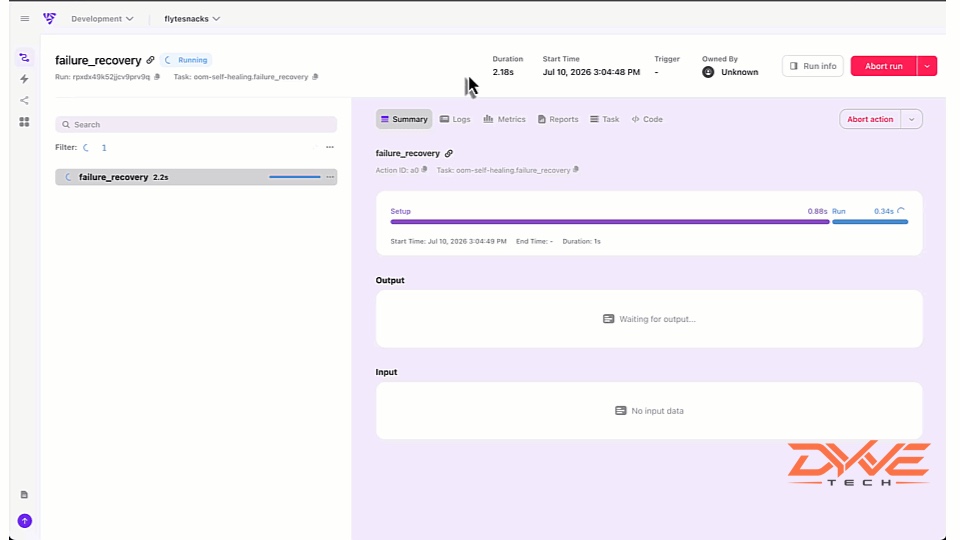
An AI runtime is the execution layer of the AI stack. It is the component that takes an AI, ML, or agentic workflow from a local script running on a laptop to a resilient process that survives production environments. A durable runtime is one that can actually monitor your infrastructure and self-heal from infra-caused failures.
Your model handles the intelligence. The runtime handles everything around it that breaks:
• Recovery: Managing code or infrastructure failures mid-job.
• Durability: Sustaining jobs that run for hours or days without losing state.
• Dynamic Adaptation: Supporting agentic workflows that change their execution path on the fly.
Whether you are doing model training, reinforcement learning, batch processing, or real-time inference, the runtime is the bridge to production.
Why Traditional Orchestrators Keep Losing in the AI Era
A traditional orchestrator requires the full execution graph upfront. You hand it a Directed Acyclic Graph (DAG), and it executes exactly that DAG.
That contract is perfect for nightly ETL processes, but it collapses the moment a workflow needs to decide its next step agentically. Consider an AI agent that picks its next tool based on a previous output, a training job that forks based on a validation metric, or a research pipeline that fans out dynamically based on what it discovers. Every traditional orchestrator assumes you know the whole plan before the first task runs.
When a workflow decides its own next step at runtime, that assumption breaks. This is the most common failure story behind why AI agents fail in production.
And when something dies at 3:00 AM? The orchestrator’s usual answer is to restart the whole run from the top—on GPUs that are billed by the minute. This pain compounds in three specific ways:
1. Invisible Infrastructure Failures: Issues like OOM errors, node interruptions, and container preemptions are either totally invisible to the developer or require manual intervention.
2. Slow Iteration: The "run-break-debug-restart" loop is an entirely manual, time-consuming process.
3. Astronomical Compute Costs: Brittle workflows drive up costs. When a long job dies and restarts from zero, you pay twice for every GPU-hour it already burned.
The "Duct Tape" Stack
To compensate for orchestrator limitations, teams build the missing execution layer themselves, one incident at a time.
They add a scheduler here, custom retry decorators there, and a checkpointing script written hastily after the last OOM crash. They bolt on a separate serving stack for inference because the orchestrator was never meant to serve models. They layer a dashboard over the top that can see the tasks but never the underlying state.
Every seam between these isolated systems is a place where execution state gets lost. The orchestrator triggers a retry without knowing a checkpoint exists. The serving stack has no idea the model behind it just finished retraining. Engineers end up debugging the glue code more often than the actual workload.
An AI runtime argues that one layer should own execution state, ensuring that recovery, inference, and observability all read from the exact same source of truth.
Enter Flyte 2: The First Open-Source AI Runtime
On August 4, Union.ai shipped Flyte 2, the first open-source AI runtime designed to scale durable AI, ML, and agentic workloads on your own infrastructure.
Flyte is already entrenched in engineering teams, boasting tens of millions of downloads and over 4,000 organizations running it (including frontier AI labs and Fortune 500 companies). Developed alongside partners like NVIDIA, Amazon, Google, and Nebius, Flyte 2 rebuilds that proven track record specifically for the AI runtime era.
Three core capabilities define this release:
• Durable, Self-Healing Workflows: Flyte 2 is infrastructure-aware. An OOM crash is something your code can catch and handle, with the ability to provision needed resources dynamically. Workflows self-heal from both logic and infrastructure failures without losing progress.
• Dynamic, Agent-Native Execution: Workflows can branch, loop, call tools, and adapt while running—without sacrificing durability. Because the execution plan is decided at runtime, agent loops become a native shape rather than a hack forced onto a fixed graph.
• Unified Batch and Real-Time Inference: Training and serving run on the same system. The need for a separate serving stack, and the fragile glue code it requires, is eliminated.
Flyte 2 comes with a production-level UI out of the box, is free to run (the backend and SDK are Apache 2.0 licensed, while the UI is source-available under a Union license), and runs entirely on your own machines or cloud environment, ensuring your data never leaves your control.
Real-World AI Runtime Use Cases
Union.ai shipped reproducible projects alongside the launch to demonstrate the runtime in action.
• LLM Post-Training with GRPO: A great starting point. This uses the full stack in a single run to implement Group Relative Policy Optimization (GRPO)—a reinforcement learning algorithm introduced by DeepSeek—to fine-tune an LLM. If a task fails mid-run, it recovers and succeeds on retry instead of restarting the entire training cycle.
• Claude Agent Research Pipeline: Showcases agent-native execution. Provide a prompt that returns several research directions, and the orchestration adapts at runtime, fanning out dynamically instead of following a pre-written script.
• Vision-Language Model (VLM) Apps: Runs a VLM in a pre-built environment natively on the same runtime that handles batch work, proving the "no separate serving stack" concept.
Keep Your Skepticism Calibrated
Before migrating your entire stack, keep these three principles in mind:
1. Prioritize Durability Over Features: Judge a runtime by whether a workflow survives an infrastructure failure at 3:00 AM. Recovery from infra and logic failures is the actual gap AI teams struggle with weekly.
2. Assess Your Workload: If your workloads are genuinely linear, deterministic, and short-lived (e.g., a nightly batch pipeline that never branches), your current orchestrator is fine. Adopting an AI runtime for a simple cron job is overkill. A runtime earns its keep when workflows get dynamic and jobs get long and expensive.
3. Budget for Migration: Adopting any new execution layer requires a migration. While being early to a General Availability (GA) release has massive upside—especially with an Apache 2.0 license and a large GitHub/Slack community—it still requires dedicated engineering time.
The Shift in Production Readiness
Production-readiness in AI has always been an execution-layer property. The industry simply spent years treating it as custom glue code that every team had to write from scratch.
Once the execution layer becomes a standardized component you adopt, rather than a hack you maintain, the failure stories change shape. A 3:00 AM OOM error transitions from a pager alert to a simple log line.
If agents or massive training runs are breaking your current setup, testing a local environment is the fastest way to validate this approach. The Flyte 2 devbox spins up locally in about five minutes, allowing you to run these workloads on your own machine before committing to a full migration.
Frequently Asked Questions (FAQ)
What is an AI runtime?
An AI runtime is the execution layer that transitions AI, ML, and agentic workflows from experimental scripts to production-grade systems. It delivers durable execution across logic and infrastructure, manages dynamic workflow paths, keeps long-running jobs secure, recovers from infra failures (like OOM errors), and supports both real-time and batch inference.
Is an AI runtime just an orchestrator with retries?
No. An orchestrator executes a rigid, upfront plan. An AI runtime owns the execution state while it happens. This allows the workflow to change its plan mid-run, recover from failures using infrastructure-aware checkpoints, and run inference on the same layer. Retries are just a single feature; owning dynamic execution state is the defining category.
When should I choose an AI runtime over a traditional orchestrator?
If your workloads are linear, deterministic, and short, a traditional orchestrator is likely sufficient. However, if you are running agentic loops, dynamic workflows, or compute-intensive AI/ML jobs that burn expensive GPU hours, a runtime becomes critical for scaling durably.
Is Flyte 2 open source, and can I run it locally?
Yes. Flyte 2 is Apache 2.0 licensed, meaning you can run it on your own infrastructure so your data remains completely private. It also fully supports local execution; the devbox provided by the community can spin up a local environment in minutes for testing.