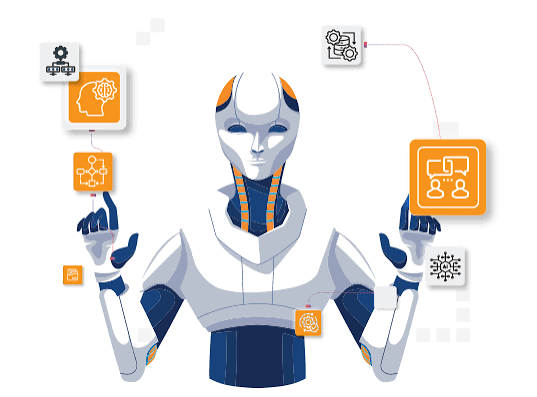
For years, artificial intelligence in the enterprise has felt like a brilliant but stubbornly reactive assistant. You type a prompt, it generates text. You set a rigid rule, it executes a script. But in 2026, that paradigm has collapsed. We have officially crossed the threshold from isolated, prompt-dependent chatbots into the era of Agentic AI—a revolutionary shift where AI systems don't just generate content; they reason, plan, self-correct, and autonomously orchestrate complex workflows.
The shift from experimentation to operational deployment is undeniable. Today, over 57% of enterprises are running AI agents in production environments. This isn't just an upgrade to Robotic Process Automation (RPA); it is a fundamental reimagining of how digital work gets done.
Here is a deep dive into how autonomous agents are dominating enterprise architecture and reshaping the modern operational pipeline.
Moving Beyond RPA: What Makes an AI "Agentic"?
To understand the revolution, we have to distinguish between traditional automation and agentic systems:
• Traditional Automation (RPA): Rigid, rule-based, and static. If a script encounters an unexpected variable or an unstructured data format, it breaks and requires human intervention.
• Agentic AI: Goal-oriented and adaptive. You give an agent an objective, and it breaks that goal down into actionable, multi-step plans. If it hits a roadblock, it replans and self-corrects dynamically.
This capability is powered by a structured pathway: perceive, reason, act, and learn. Agents retain context through persistent memory architectures, which have been shown to drastically reduce latency and compute costs while boosting accuracy.
Multi-Agent Orchestration: The New Digital Workforce
The most defining trend of 2026 is the rise of multi-agent architectures. Instead of relying on a massive, monolithic AI model to handle everything, enterprises are deploying specialized teams of digital workers.
By breaking workflows into discrete functions managed by a central orchestrator, organizations are achieving unprecedented speed and resilience. The enterprise segment of the agentic AI market is growing at a staggering 46.2% CAGR, reflecting a massive appetite for these coordinated systems.
Real-World Use Cases Reshaping Operations
Agentic AI is leaving the sandbox and natively embedding itself directly into DevOps pipelines, cloud infrastructures, and core operational platforms.
• Automated Web Development & Deployment: Development teams are leveraging autonomous agents to streamline heavy technical pipelines. For instance, an architect can build a dashboard where a user simply uploads a zipped web framework file (like Next.js), clicks a button, and an agentic workflow takes over. The agent manages the remote cloud execution, orchestrates the conversion of those framework files into static HTML, and automatically pushes the optimized build to a hosting environment like Vercel.
• SEO & Crawler Indexing Management: Maintaining visibility across complex web platforms requires constant vigilance. Specialized SEO agents can now autonomously audit and update crawler indexing configurations. If a company launches a new cyber intelligence platform, an agent can dynamically evaluate and optimize the robots.txt file, ensuring deep, mobile-first indexing without requiring manual developer oversight.
• Content Pipelines: Modern media and tech platforms are using multi-agent systems to power their mobile-first publishing engines. A research agent curates trending tech news, a drafting agent formats the article for high SEO performance, and an orchestration agent ensures the final piece is pushed live to clean, folder-based URL structures.
• Financial Operations: Agentic workflows are autonomously routing invoices, matching purchase orders, flagging exceptions, and processing payments across ERP systems.
The Integration Imperative
Perhaps the biggest catalyst for this boom is how frictionless integration has become. We are no longer bolting AI onto the outside of our tool stacks. Modern agent platforms come with deep, pre-built integrations for thousands of business applications.
They operate directly inside DevOps pipelines, Slack channels, and enterprise analytics platforms. Gartner predicts that by 2026, 40% of enterprise applications will include task-specific AI agents, a massive leap from less than 5% just a year prior.
Governance: Navigating the Dark Side of Autonomy
With great autonomy comes great operational risk. Allowing software to make independent decisions across your enterprise stack introduces new vectors for costly mistakes. Analysts note that over 40% of agentic projects risk abandonment due to unclear ROI or misapplied autonomy.
To succeed, enterprises must treat agents as identity-bearing entities and implement strict governance:
1. Human-in-the-Loop (HITL): Critical decisions—especially those with financial, legal, or reputational stakes—must still route to human reviewers for final approval.
2. Tiered Model Routing: Because continuous agent loops can accumulate massive cloud compute costs, smart architectures route routine tasks to lightweight, low-cost models, reserving premium reasoning models only for complex orchestrations.
3. Observability: Visual dashboards that allow developers to track an agent's reasoning process, API calls, and workflow progress in real-time are non-negotiable.
The Road Ahead
The Agentic AI revolution is not a distant future state; it is the current reality of enterprise software. Organizations that successfully transition from isolated AI tools to fully integrated, multi-agent ecosystems will achieve a level of operational scalability that was previously impossible.
The mandate for tech leaders in 2026 is clear: start integrating adaptive orchestration, enforce strict observability, and let your digital workforce handle the execution while you focus on the architecture.